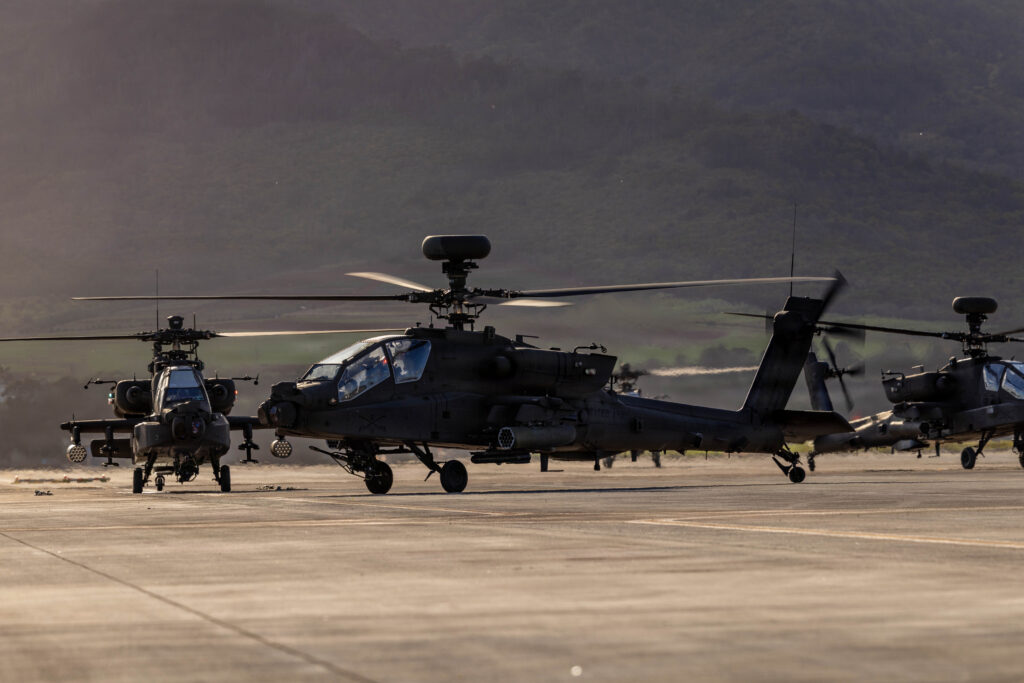

In a significant advancement for military aviation training, augmented reality (AR) developer Red 6 has successfully integrated its sophisticated training system into a Boeing testbed for the Boeing AH-64E Apache attack helicopter. This collaboration marks the first time AR technology has been incorporated into a U.S. Army platform and represents a new frontier for combat helicopter pilot training.
The milestone was achieved by integrating Red 6’s Advanced Tactical Augmented Reality System (ATARS) into Boeing’s AH-64E Crewstation Advanced Technology Testbed (CATT). The fusion of these technologies promises to revolutionize how Apache pilots prepare for complex, multi-domain combat scenarios, enhancing readiness while managing the costs and logistical challenges of traditional training exercises.
A New Era for Combat Helicopter Training
The integration of ATARS onto the Apache platform is a landmark achievement. While AR and virtual reality (VR) have become staples in ground-based simulators, Red 6’s system is designed to work in the aircraft itself during actual flight. This allows pilots to experience highly realistic, dynamic training scenarios in a true-to-life environment.

This development is the first of its kind for a combat rotorcraft, bringing the synthetic training environment directly into the cockpit. By enabling pilots to see and interact with virtual threats and assets while airborne, the system bridges the critical gap between sterile simulation and high-stakes live-fire exercises. This provides a level of realism previously unattainable in flight training.
How the ATARS System Revolutionizes Training
The Red 6 ATARS technology overlays a high-fidelity layer of augmented reality onto the pilot’s field of view. This allows the system to generate a multitude of virtual scenarios that pilots can interact with in real-time. The training possibilities are extensive and address critical modern combat needs.
Key Training Scenarios Enabled by ATARS:
- Air-to-Air Combat: Pilots can engage in realistic dogfights against virtual adversary aircraft, simulating peer-level threats without the need for actual aggressor squadrons.
- Complex Ground Threats: The system can generate virtual enemy ground forces, anti-aircraft systems, and other surface-to-air threats, allowing for realistic mission rehearsals.
- In-Flight Refueling: Pilots can practice complex logistical operations like aerial refueling with virtual tanker aircraft.
- Manned-Unmanned Teaming: Crucially, ATARS can simulate autonomous “loyal wingmen” or Collaborative Combat Aircraft (CCA), enabling pilots to train for the future of warfare by commanding and coordinating with unmanned systems.
By moving these complex training events into a secure, augmented environment, the U.S. Army can significantly reduce the financial and logistical burden of large-scale field exercises, while simultaneously increasing the frequency and complexity of pilot training.
Strategic Partnership and Future Implications
This achievement builds on an existing partnership between Red 6 and Boeing, which previously saw the two companies collaborate on an advanced pilot training system for the T-7A Red Hawk jet trainer. The expansion of this partnership into the vertical lift domain underscores a shared commitment to innovating military training methodologies.
Kathleen Jolivette, vice president and general manager of Boeing’s Vertical Lift division, highlighted the importance of this technological leap. “Augmented reality technologies, like ATARS, open up new opportunities to prepare military aviators for the complex threat environments they face today and will face in the future,” she stated.
The successful integration is not just a technical demonstration but a strategic step towards building a more agile and prepared fighting force. As the nature of global threats evolves, the ability to train against a near-limitless array of virtual scenarios provides a decisive advantage in pilot readiness and adaptability.
The Boeing AH-64E Apache: A Platform for Innovation
The selection of the AH-64E Apache as the platform for this groundbreaking integration is fitting. As the U.S. Army’s premier attack helicopter, the AH-64E Guardian is the most advanced multi-role combat helicopter in service, operated by the U.S. and a growing number of allied nations.
The “E” model is a significant upgrade over its predecessors, featuring more powerful T700-GE-701D engines, upgraded electronics, and enhanced digital connectivity. One of its key design features is its ability to perform manned-unmanned teaming (MUM-T), allowing Apache pilots to control unmanned aerial vehicles (UAVs). The ATARS system directly enhances this capability by allowing pilots to practice these complex teaming operations in a safe and repeatable augmented environment.
By using such an advanced and widely deployed platform as a testbed, Boeing and Red 6 are ensuring that the benefits of augmented reality Apache pilot training can be scaled and implemented where they are needed most.
This integration of augmented reality marks a pivotal moment, promising a future where pilots can train for the most demanding missions with unprecedented realism and efficiency, ensuring they remain the most lethal and effective fighting force in the world.