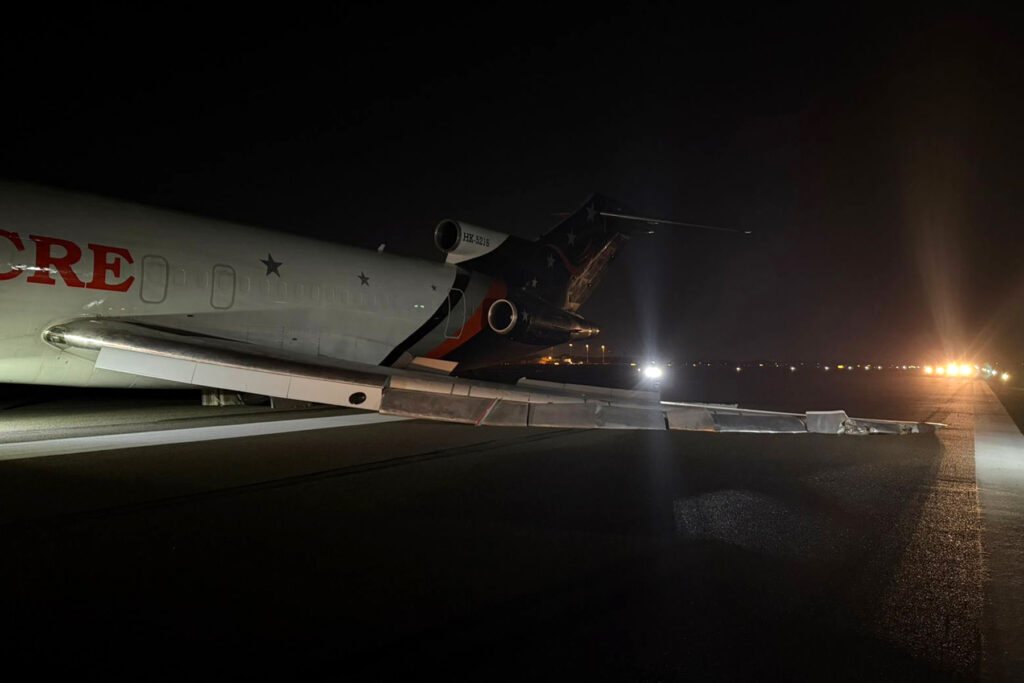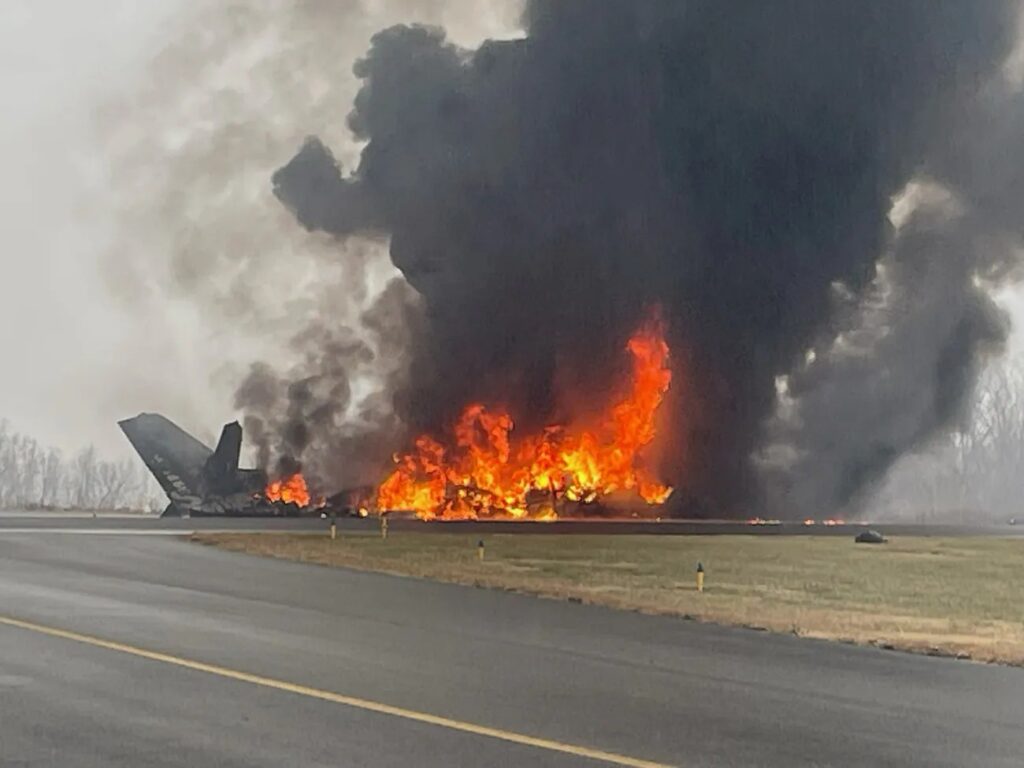

A Boeing 727 freighter operated by Aerosucre was involved in a serious landing accident at Ernesto Cortissoz International Airport in Barranquilla, Colombia, on December 12, 2025. The jet, widely recognized in the region for its role in cargo operations, suffered major structural damage after an unstable touchdown that quickly escalated into an emergency on the runway. Despite the severity of the impact, authorities confirmed that all crew members survived and were treated on site.
The sequence of events: what the footage reveals
Several videos recorded by airport personnel and passengers in the terminal captured the moment the 727 touched down. In the clips, the tri-jet appears to approach the runway with a noticeable right-wing drop, followed almost instantly by a burst of flame from the right engine. The aircraft then veers off balance as the landing gear collapses under the stress of the impact.
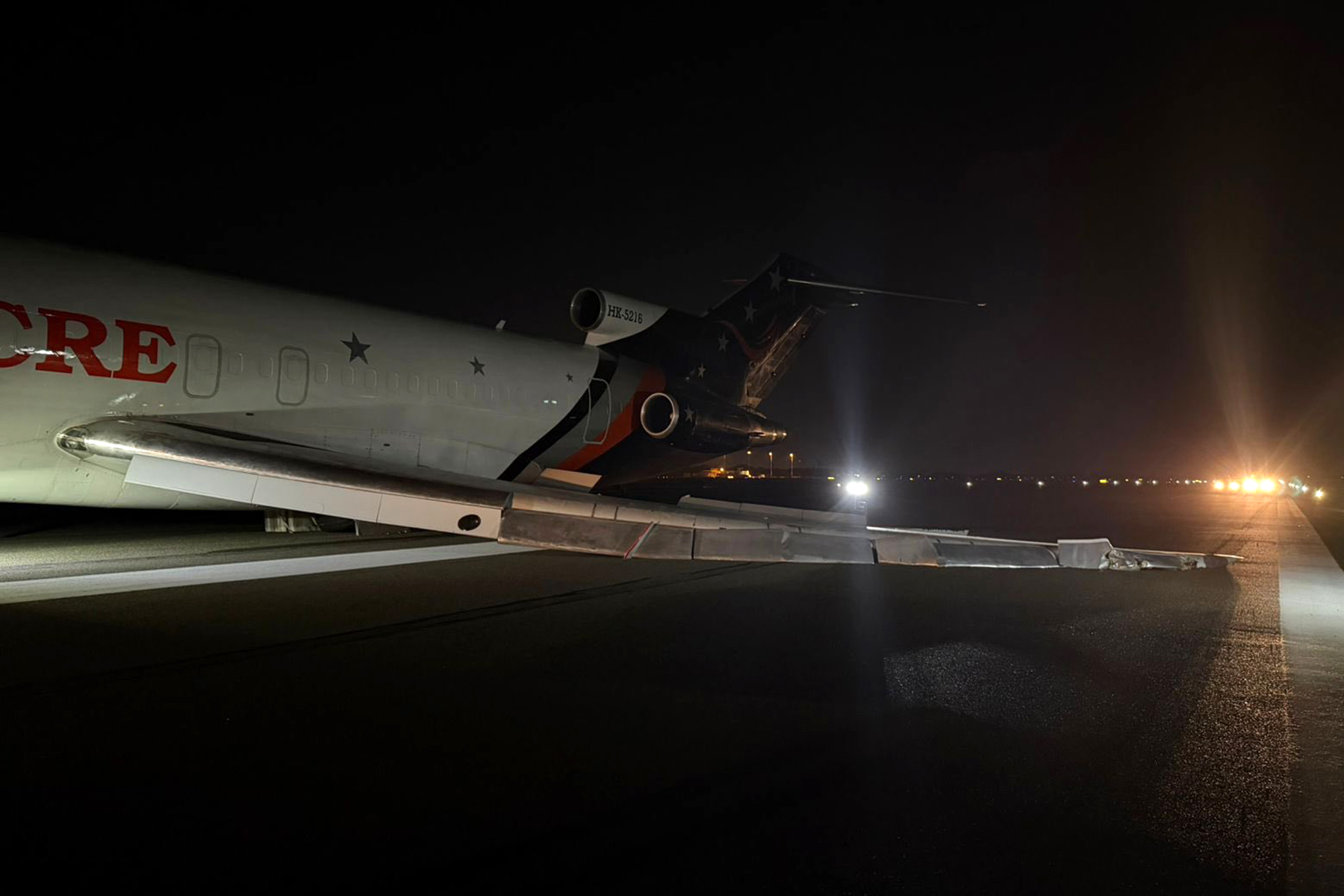
Witnesses on the ramp said the aircraft “looked unstable long before it crossed the threshold.” The Boeing 727, which requires precise handling during landing due to its configuration and engine placement, slid across the pavement for several dozen meters before coming to a stop surrounded by smoke and sparks.
Airport firefighters responded within seconds, covering the aircraft with foam and securing the area to prevent a fuel-fed fire. The rapid intervention was key to avoiding a more serious incident.
Emergency response and temporary shutdown of operations
As soon as the aircraft came to rest, the airport activated its full emergency protocol. All operations at Ernesto Cortissoz Airport were suspended, and the runway was declared closed until safety teams could assess the scene.
The crew of the 727 managed to evacuate the cockpit before flames spread. One crew member was transported to a hospital for precautionary checks, while the others remained under observation at the airport.
Una nueva emergencia aérea encendió las alarmas en el aeropuerto Ernesto Cortissoz la madrugada del día de hoy. El Boeing 727-200 carguero de la aerolínea AeroSucre, con matrícula HK-5216, se vio obligado a realizar un retorno de emergencia poco después de su despegue. pic.twitter.com/5yxFo56Fwh
— Colombiaalaire.com (@colombialaire) December 12, 2025
Because the damaged jet blocked a critical section of the runway and left debris, hydraulic fluid and fuel on the pavement, multiple flights were diverted to Cartagena, Santa Marta and Bogotá. The airport remained partially closed until heavy equipment was brought in to lift the 727 and tow it away from the landing area.
Early investigation: possible causes under review
Colombia’s Aeronáutica Civil has already confirmed that a formal investigation is underway. Although it is too early for definitive conclusions, several technical possibilities are being considered:
- Collapse of the right landing gear: videos strongly suggest a structural failure at touchdown, which could explain the sudden tilt of the aircraft.
- Engine malfunction: the visible flame from the right engine may indicate compressor issues or a mechanical failure that reduced directional control.
- Unstabilized approach: the aircraft’s angle and drift suggest that the approach may not have met stabilized-landing parameters.
- Wind or crosswind influence: conditions at the time included variable winds capable of affecting lateral handling on final approach.
Investigators have retrieved the flight data recorder (FDR) and the cockpit voice recorder (CVR). These will help reconstruct the flight path, control inputs and any warnings received during the final seconds before the impact.
About the aircraft: a classic freighter still active in Latin America
The Boeing 727, once one of the most common jets in global aviation, is now rare in most of the world but still operated by a handful of Latin American cargo carriers, including Aerosucre. The aircraft involved in the accident was configured specifically for freight operations and regularly flew short-haul logistics routes across Colombia’s Caribbean region.
While aging aircraft can continue to operate safely with proper maintenance, their systems require strict monitoring. The investigation will examine the 727’s maintenance records, recent inspections, engine history and landing gear cycles to determine whether mechanical issues contributed to the accident.
Operational consequences for the airport
The accident significantly disrupted activity at Barranquilla’s main airport. The runway remained closed for several hours while specialists removed the 727 and assessed the structural condition of the pavement.
Airlines operating from Ernesto Cortissoz faced delays, cancellations and diversions. Airport authorities emphasized that restoring safe operations took precedence over reopening quickly, especially given the presence of fuel residue and metal debris scattered across the runway.
What comes next in the investigation
The Aeronáutica Civil will now move forward with a detailed evaluation including:
- Analysis of CVR and FDR data to reconstruct the approach and landing.
- Interviews with the flight crew to understand cockpit conditions.
- Examination of the landing gear, engine components and hydraulic systems.
- Assessment of weather conditions and air traffic control communications.
- Evaluation of the aircraft’s maintenance and operational history.
The final report may take several months but is expected to clarify whether the accident resulted from mechanical failure, operational factors, environmental conditions — or a combination of them.
Conclusion: a dramatic event with no loss of life
The accident involving the Aerosucre Boeing 727 was visually dramatic and caused a full airport shutdown, but it ended without fatalities thanks to the quick action of emergency teams and the crew’s ability to exit the aircraft in time.
As the investigation progresses, the findings will help strengthen safety measures for cargo operations in Colombia and provide insight into the continued use of older tri-jet freighters in demanding environments. For now, the incident stands as a stark reminder of the challenges associated with operating legacy aircraft and the importance of swift, coordinated emergency response in modern aviation.