
Beijing, China – After more than a decade of speculation, China’s next-generation medium tactical transport aircraft, unofficially designated the Y-30, has reportedly completed its maiden flight. Grainy images and video clips that surfaced on Chinese social media platforms on December 18, 2025, appear to show the prototype airborne near a Xi’an-based airfield, marking a significant milestone in the modernization of the People’s Liberation Army Air Force (PLAAF) airlift capabilities.
The successful test flight of the China Y-30 transport aircraft signals Beijing’s intent to develop a robust, indigenous fleet capable of supporting a wide range of military and humanitarian operations. While Chinese officials have yet to formally acknowledge the program’s existence or the recent flight, the visual evidence provides the clearest confirmation to date that the project has advanced to the prototype testing phase.
A Long-Awaited Debut
The Y-30 first entered public consciousness when a scale model was unveiled at the Zhuhai Airshow in 2014. Following this reveal, the program receded from public view, leading to years of discussion among defense analysts about its status. The emergence of a flying prototype validates long-held beliefs that China was actively pursuing a modern tactical airlifter to fill a crucial gap in its fleet.
The aircraft is understood to be a product of the Shaanxi Aircraft Corporation (SAC), a subsidiary of the state-owned Aviation Industry Corporation of China (AVIC). SAC is China’s premier manufacturer of medium transport aircraft, having developed and produced the widely used Y-8 and its successor, the Y-9, both of which were based on the Soviet-era Antonov An-12.
Analysis of the Y-30 Prototype
The images circulating online, though of low resolution, offer valuable insights into the Y-30’s design philosophy, which emphasizes efficiency, performance, and operational flexibility from varied environments.
Design and Aerodynamic Features
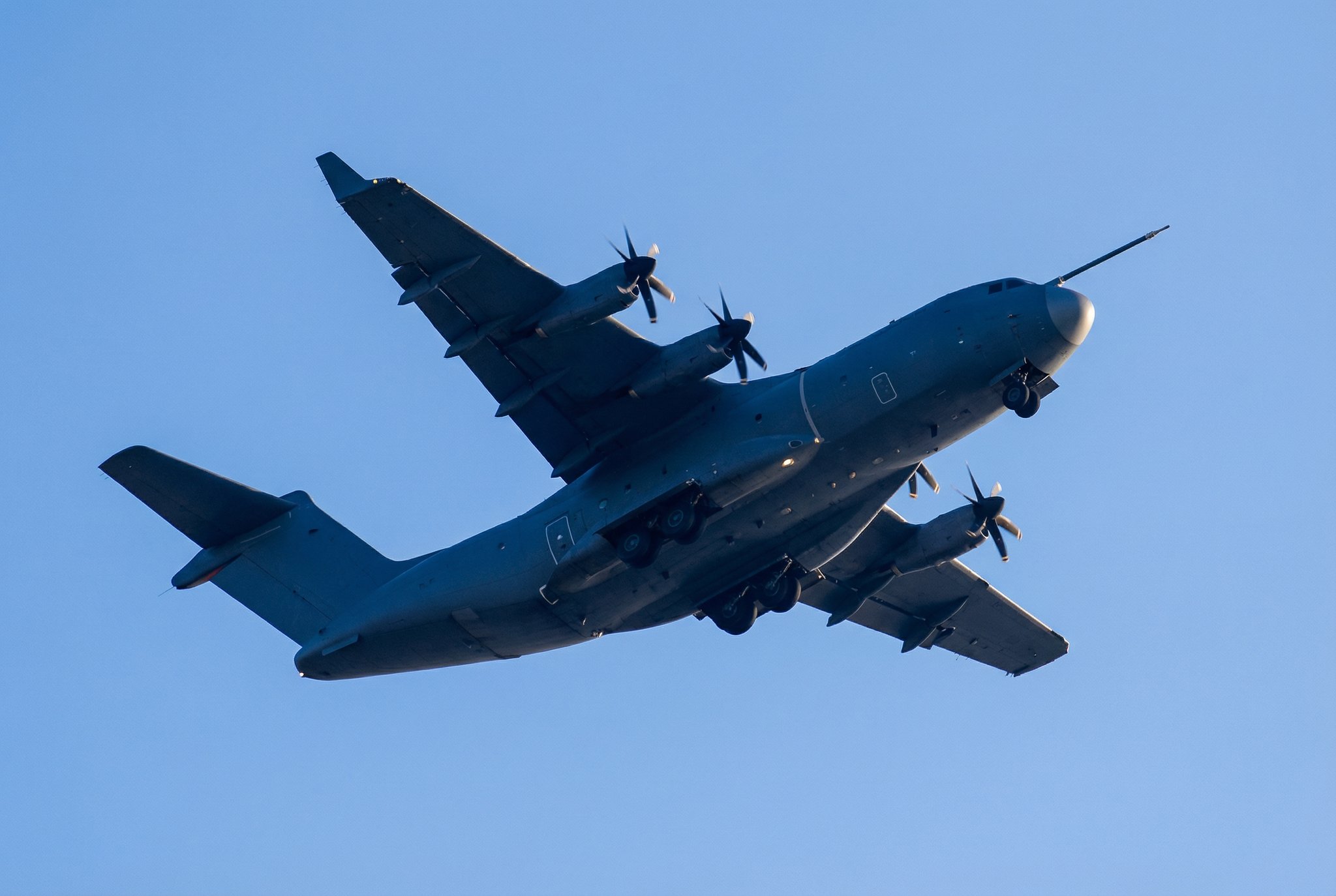
The Y-30 prototype showcases a conventional but modern airframe for a tactical transport. Key characteristics observed include:
- A high-wing configuration, which allows for a spacious cargo hold free of structural intrusion and provides greater clearance for engines and propellers when operating from unprepared surfaces.
- A T-tail empennage, which keeps the horizontal stabilizers out of the propeller wash and engine exhaust, improving aerodynamic efficiency.
- Prominent winglets at the tips of the wings, designed to reduce induced drag and improve fuel efficiency, thereby extending range and endurance.
- A robust, multi-wheel landing gear system, suggesting the aircraft is engineered for short-field takeoffs and landings (STOL) on austere or semi-prepared airstrips.
- A distinct nose-mounted air-data boom, a standard piece of equipment on test aircraft used to gather precise flight data during the initial evaluation phase.
Propulsion System
The aircraft is powered by four turboprop engines, each driving a modern six-bladed composite propeller. Analysts speculate that the powerplants are likely either the WJ-10 or the more advanced WJ-16 engine, with power outputs estimated to be between 5,000 and 7,000 horsepower per engine. This configuration is optimized for providing high thrust at lower speeds, which is essential for short-runway performance while carrying heavy loads.
Strategic Role in the PLAAF Airlift Fleet
The Y-30 is strategically positioned to enhance the PLAAF’s operational flexibility by bridging the payload gap between its existing transport assets. It represents a significant step forward from legacy platforms and complements the larger strategic airlifter in the fleet.
Bridging a Critical Capability Gap
With an estimated maximum payload capacity of around 30 metric tonnes, the Y-30 fits neatly between the 25-tonne capacity of the current Y-9 medium transport and the 60+ tonne capacity of the Xi’an Y-20 Kunpeng strategic airlifter. This allows the PLAAF to deploy medium-weight armored vehicles, artillery, and substantial troop numbers more efficiently than before.
This new capability will enable the PLAAF to undertake a broader range of missions, including rapid regional deployment, airborne assaults, humanitarian aid delivery, and disaster relief, without having to rely on the oversized Y-20 for medium-sized loads.
Comparison with Global Counterparts
The Y-30’s specifications place it in a competitive segment of the global military transport market. While often visually compared to the Airbus A400M, the Y-30 is smaller and appears to be in a different payload class.
Its closest Western competitor in terms of role and payload is likely the venerable Lockheed Martin C-130J Super Hercules. However, the Y-30 is believed to have a wider and taller cargo bay, offering greater internal volume for outsized cargo. Its payload capacity of 30 tonnes also surpasses the C-130J’s approximate 20-tonne limit, placing it in a unique category similar to that of the Brazilian Embraer C-390 Millennium jet transport.
The Path Forward
The first test flight of the China Y-30 transport aircraft is just the beginning of a comprehensive development and certification program. The prototype will undergo rigorous testing to validate its performance, safety, and reliability before any series production can begin. Future variants could incorporate additional features, such as an aerial refueling probe, which was not visible on the initial prototype.
Upon entering service, the Y-30 is expected to gradually replace the PLAAF’s aging fleet of Y-8 aircraft and significantly enhance the capabilities offered by the more modern Y-9. This development underscores China’s continued investment in building a world-class, self-sufficient defense industry and a military with global power projection capabilities.