
An experienced Australian skydiver has survived a terrifying mid-air emergency in Queensland, becoming entangled in the tail of a Cessna 208 aircraft at 15,000 feet after a premature parachute deployment. A report from the Australian Transport Safety Bureau (ATSB), released December 11, 2025, details the harrowing skydiving incident that occurred on September 20, where quick thinking and specialist equipment were crucial to preventing a tragedy.
The incident, captured on video, involved a group of 16 skydivers preparing for a formation jump. The dramatic footage shows the skydiver dangling precariously from the aircraft’s horizontal stabilizer. The successful outcome of this skydiver plane tail entanglement survival story is being credited to the individual’s composure and the pilot’s skillful handling of the compromised aircraft.
The Incident Unfolds at 15,000 Feet
The skydiving operation, conducted by the Far North Freefall Club, began as a routine flight. As the first skydiver moved towards the exit door of the Cessna 208, the handle of his reserve parachute unexpectedly caught on a flap of the aircraft’s left wing. This snag triggered an immediate and accidental deployment of the reserve canopy.
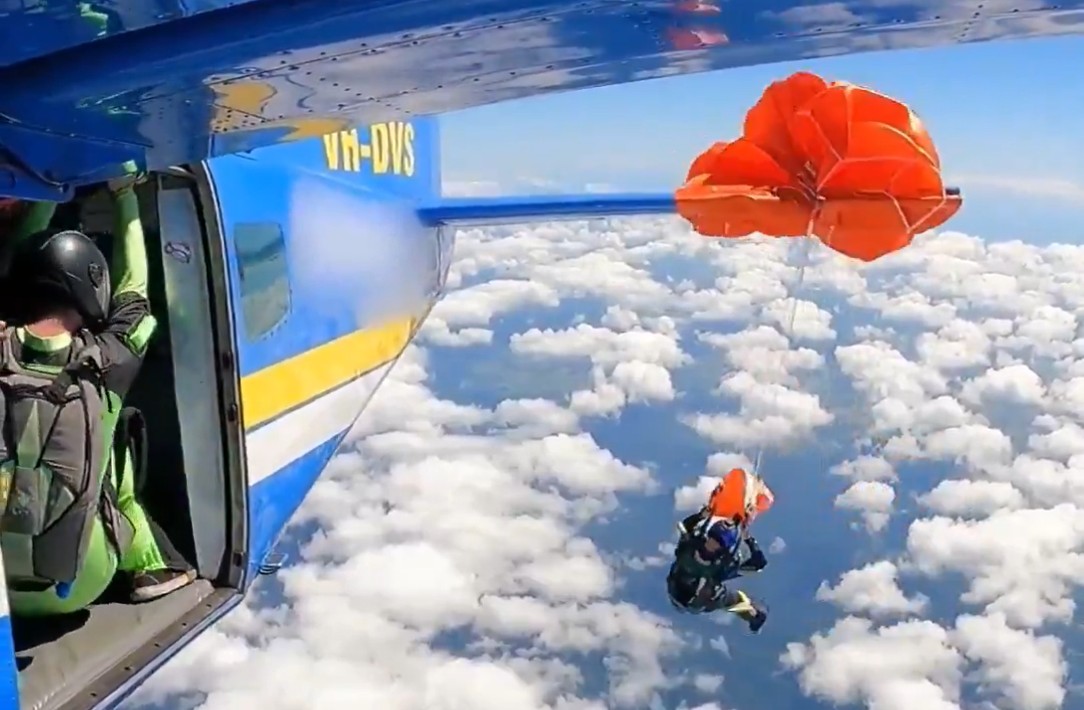
The force of the deploying parachute knocked another skydiver into an unplanned free fall. Simultaneously, it violently pulled the first jumper backward, causing him to become entangled with the aircraft’s tail assembly. He was left suspended beneath the horizontal stabilizer, a critical flight surface, creating a perilous situation for both the skydiver and the aircraft.
A Harrowing Ordeal Captured on Video
Onboard video documents the severity of the emergency. The skydiver can be seen hanging helplessly from the tail as the pilot fights to maintain control of the aircraft, which investigators noted had pitched up sharply. Despite the obvious danger, 13 other parachutists proceeded with their planned exit, navigating past their stranded colleague to begin their descent.
This critical phase of the skydiver plane tail entanglement highlighted the extreme risk, as any sudden movement or equipment failure could have had catastrophic consequences for everyone involved.
A Desperate Fight for Survival
The entrapped skydiver, a veteran with over 2,000 jumps across a 21-year career, remained composed under unimaginable pressure. Relying on his extensive training, he began a methodical process of self-extraction. Using a hook knife attached to his chest, he started meticulously cutting away the lines of the snagged reserve parachute.
The ATSB report emphasized that this piece of equipment likely saved his life. The ability to sever the entangled parachute lines was the only viable means of escape from the aircraft’s tail. After successfully freeing himself, the parachutist was able to deploy his main canopy, disentangle it from the remnants of the reserve chute, and navigate to a safe landing. He sustained only minor leg injuries from the initial impact with the aircraft.
Pilot’s Critical Role in the Emergency
The pilot of the Cessna 208 was initially unaware of the specific cause of the problem but immediately felt the aircraft slow abruptly and pitch upwards. He skillfully worked to stabilize the plane, which was now flying with a person and a parachute creating significant drag and aerodynamic interference on its tail.
Wearing his own emergency parachute, the pilot considered bailing out after the other jumpers had exited. However, once he saw the trapped skydiver cut himself free, he focused on bringing the damaged aircraft back safely, successfully landing at Tully Airport despite the damage sustained during the incident.
Investigation Findings and Safety Recommendations
The Australian Transport Safety Bureau conducted a thorough investigation into the skydiving incident. While the report faulted the Far North Freefall Club and the pilot for not ensuring the aircraft was correctly loaded for weight and balance, it concluded that this factor did not contribute to the parachute snag or the ensuing emergency.
Following the event, the skydiving club took proactive steps to enhance its safety protocols. According to the ATSB, the operator has strengthened its procedures, which now include a mandatory requirement for all parachutists to carry a hook knife. Furthermore, the club has reinforced its pre-flight weight-and-balance checks to ensure full compliance.
A “Unique and Extreme” Survival
Industry experts have praised the actions of those involved. In comments to ABC Australia, Stephen Porter, Chief Executive of the Australian Parachute Federation, described the situation as “unique and extreme.” He commended both the skydiver and the pilot for their calm and professional conduct under immense pressure.
“All things considered, everyone walked away,” Porter stated. “That’s the best possible outcome in an event like this.” The successful resolution of this near-disaster serves as a powerful testament to the importance of emergency training, proper equipment, and decisive action in the world of aviation.